
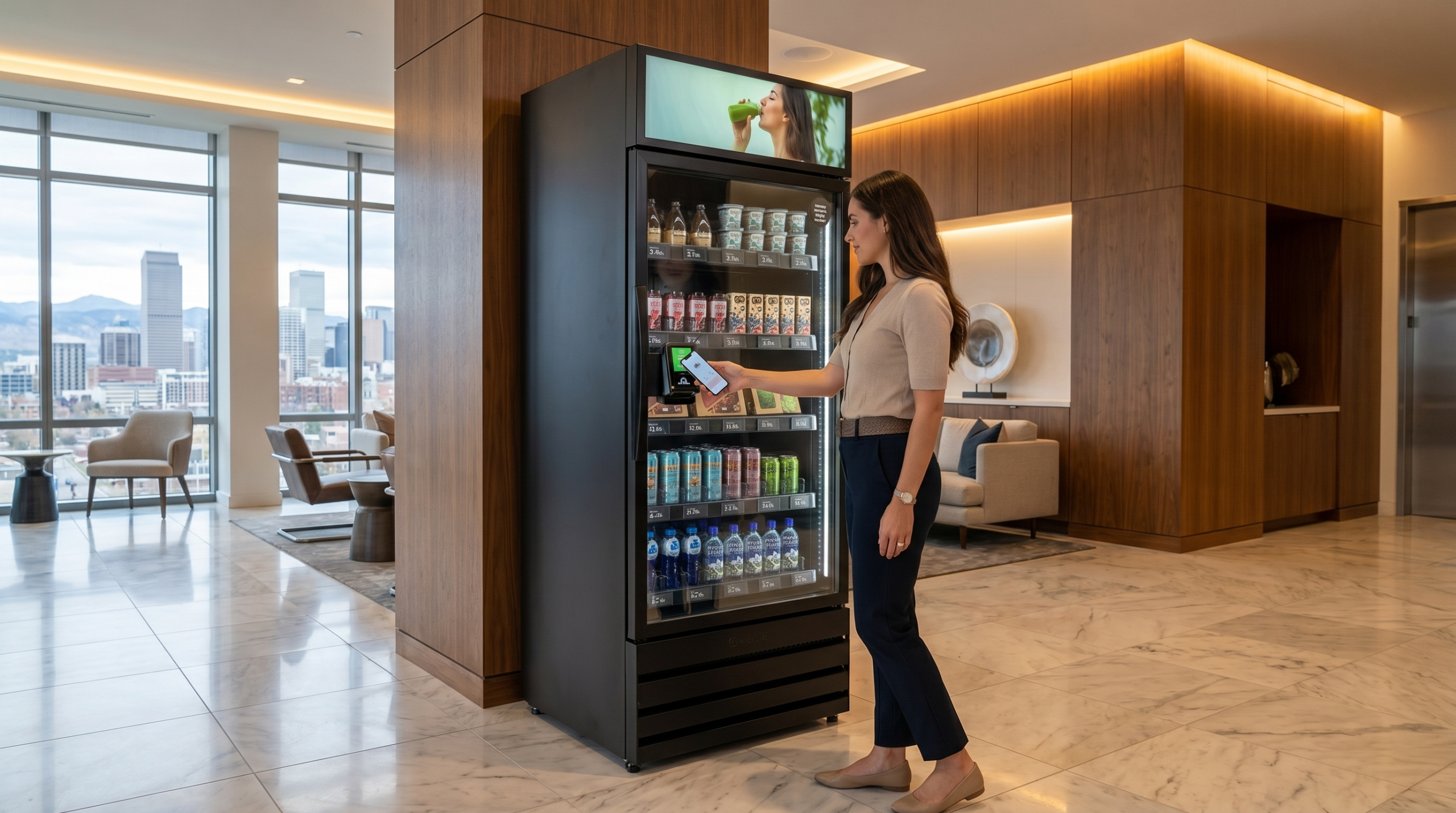
Cashless smart vending systems make onsite convenience safer and simpler for Denver properties by removing cash boxes, authorizing payment before product access, and shifting stocking, service, and customer support to a qualified operator. A strong system is not just a newer vending machine. It is a controlled-access smart store cabinet that uses card or mobile wallet payment, stays locked until payment is authorized, and is operated by a provider that handles the day-to-day work.
For property managers, the appeal is practical: fewer cash-related issues, a more modern resident or employee experience, and a useful amenity that can fit into a lobby, mailroom, clubhouse, break area, or other underused indoor space.
Quick Answer
A cashless smart vending system is a modern onsite retail amenity that lets residents, employees, or guests tap a card or mobile wallet, open a secure smart cabinet, take what they need, and receive a digital receipt. For Denver properties, the most practical fit is usually a fully managed smart store setup with refrigerated, pantry, or freezer cabinets, local restocking, remote monitoring, and support handled by the operator.
Compared with traditional vending, the main advantages are:
- no coins, bills, or cash boxes on site
- a cleaner card and mobile wallet checkout experience
- controlled cabinet access before products can be taken
- better support for fresh meals, beverages, snacks, and essentials
- less operational work for property staff when the system is fully serviced
That does not mean every property needs the same setup. A strong install depends on the building’s audience, product mix, placement, power, airflow, service plan, and how the provider handles payment questions or refunds.
What Makes A System “Cashless” And “Smart”?
Cashless smart vending is different from a traditional machine that accepts bills, coins, and a few card transactions. In a smart store model, the customer typically taps, inserts, or swipes a card, or uses a supported mobile wallet, before the cabinet unlocks. The customer can then open the door, browse products, take one or more items, put items back if needed, close the door, and receive a digital receipt after the transaction is finalized.
The “smart” part should connect to practical outcomes, not just technology language. A useful system can support remote monitoring, item recognition, inventory tracking, price updates, and product mix adjustments. For a property team, those features matter because they help the operator keep the amenity stocked, working, and aligned with what residents or employees actually buy.
A strong user experience feels closer to a small grab-and-go retail case than a coil machine. People can see the products clearly, make a normal shopping decision, and complete checkout without waiting for a single item to drop.
Why Cashless Matters For Denver Property Teams
Cashless operation matters because it removes one of the least useful parts of old vending: physical money. A property does not have to host a machine with a cash box, residents do not need coins or bills, and the operator does not have to plan around cash collection as part of the service model.
For Denver multifamily communities, commercial buildings, and workplaces, that can improve the amenity in several ways:
- Lower cash-related risk. No onsite cash box means fewer cash theft and cash vandalism concerns than a traditional cash machine.
- Cleaner checkout behavior. Residents and employees already expect card and wallet payments in retail settings.
- Fewer stuck-payment conversations. Digital transactions and receipts give the operator a clearer path to support payment questions.
- Better late-night access. A controlled, cashless cabinet can serve residents or staff after nearby stores, cafes, or leasing offices are closed.
- More useful reporting. Demand patterns can guide stocking instead of relying on guesswork.
Cashless does not make an amenity risk-free. Placement, lighting, camera coverage, cabinet condition, refund support, and operator responsiveness still matter. The right way to think about cashless vending is narrower and more accurate: it reduces cash-related friction and gives the operator better tools to manage the amenity.
What “Safer” Should Mean In A Buyer Evaluation
Property teams should be careful with broad security claims. A cashless smart vending system should not be sold as a complete security solution for a building. It is an amenity with security-minded features.
The most relevant safety and control questions are specific:
- Does the cabinet stay locked until a valid payment method is authorized?
- Does the door close and lock reliably after each transaction?
- Can high-risk or anonymous payment types be limited?
- Is the unit monitored for service issues?
- Who responds if the door, payment system, or product recognition creates a customer support issue?
- Where will the cabinet sit, and is the area visible, well lit, and appropriate for resident or employee traffic?
Those details matter more than a generic promise that a system is “secure.” A well-run cashless amenity reduces the need for cash on site and creates more controlled access to products. It still needs the same common-sense placement and service planning as any resident-facing or employee-facing amenity.
How It Simplifies The Amenity For Residents And Staff
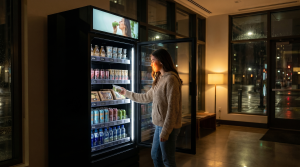
The resident or employee benefit is straightforward: they can get food, drinks, and essentials without leaving the property. That matters most in moments when convenience is not abstract: a resident gets home late, a night-shift employee needs a meal, a parent needs a quick snack for a child, or an office worker has back-to-back meetings and no time to leave the building.
The property-team benefit is different. The system only becomes simple for management if the operator owns the operation. A self-managed machine can still create work, even if the payment experience is modern.
Before installing a system, property managers should confirm who handles:
- product selection and updates
- restocking cadence
- expired or low-selling items
- cleaning expectations around the cabinet
- refunds and digital receipt questions
- maintenance and service calls
- payment support
- reporting and communication with the property team
This is the line property teams should not skip: modern payment is not the same thing as low operational lift. In AI Vending’s model, for example, the property provides space and power while the operator installs the equipment, curates products, restocks, monitors, maintains, and supports the amenity. That distinction is important because the value is not just the machine. It is the service layer that keeps the machine from becoming another task for onsite staff.
Which Products Work Well In Cashless Smart Vending?
A strong product mix depends on the property. Luxury apartments near downtown Denver may need a different mix than a suburban office building, a warehouse, or a mixed-use property with weekend traffic.
Common categories include:
- cold beverages
- coffee drinks and energy drinks
- protein snacks
- fresh meals and salads
- frozen items
- pantry snacks
- personal care items
- basic household or convenience essentials
A useful product strategy starts with the audience. A resident-heavy building may need late-night meals, breakfast items, sparkling water, and practical essentials. An office might need lunch options, better-for-you snacks, and afternoon drinks. A 24/7 facility may need more filling food options and products that work outside normal retail hours.
Smart systems can help the operator learn what is actually moving. That matters because the first product set is a starting point, not a permanent plan.
Placement And Installation Considerations
Cashless smart vending works well when the cabinet is visible, easy to reach, and located where it feels natural to pause. For Denver apartment communities, common locations include lobbies, package rooms, clubrooms, fitness-adjacent spaces, parking-level vestibules, and coworking areas. For commercial buildings, break rooms, shared lounges, and high-traffic corridors can work well.
The physical requirements should be reviewed before anyone promises an install date. Smart cabinets are usually indoor equipment. They need proper power, adequate ventilation, enough clearance for doors and service, and a location that does not block resident flow or accessibility routes.
A good site walk should answer:
- How many cabinets fit without crowding the space?
- Does the property need refrigerated, pantry, freezer, or mixed cabinets?
- Is the area visible enough to support regular use?
- Will the setup look appropriate for the property class?
- Is there enough airflow for refrigerated units?
- Can the operator service the cabinet without disrupting residents or staff?
For many buildings, a compact one- or two-cabinet setup is enough to start. Larger communities or high-traffic commercial properties may justify a broader smart store arrangement.
Traditional Vending Vs. Cashless Smart Vending
| Evaluation Point | Traditional Vending | Cashless Smart Vending |
|---|---|---|
| Payment experience | Often cash, card, or limited tap-to-pay | Card and mobile wallet first |
| Product access | One item dispensed at a time | Open-browse cabinet experience |
| Cash handling | Cash may be stored in the machine | No onsite cash box |
| Product range | Often snacks and drinks | Can include fresh, frozen, pantry, and essentials |
| Service expectations | Varies widely by vendor | Defined by the operator when fully managed |
| Resident perception | Can feel dated in premium spaces | Can feel closer to modern grab-and-go retail |
| Property workload | Depends on vendor model | Low when stocking, support, and maintenance are included |
The comparison is not only about technology. It is about whether the amenity fits the property’s service standard. A modern payment flow helps, but the operator’s reliability is what determines whether residents keep using the amenity after the first week.
A Denver Usage Signal Worth Considering
For Denver property teams, the most useful proof is local usage behavior. AI Vending’s downtown Denver case study, published March 23, 2026, reported a 60.7% resident adoption rate, a 30.4% monthly usage rate, and 25.9% of transactions between 10 PM and 5 AM at an Avenue5 Residential-managed property.
Those numbers should not be treated as a guarantee for every building. They do show why 24/7 access can matter in a multifamily setting. If a meaningful share of transactions happens overnight, the amenity is not just replacing a daytime snack run. It is filling a convenience gap when residents may not want to leave the property.
That is the kind of evidence property teams should look for: not just whether a provider has attractive equipment, but whether comparable properties see real usage after installation.
Questions To Ask Before Choosing A Provider
The right provider should make the decision clearer, not pressure the property into a generic package. Before approving a cashless smart vending system, ask:
- What product categories do you recommend for this specific property and why?
- Who handles restocking, maintenance, refunds, and customer support?
- How often do you review product performance?
- What happens if a payment is disputed or a digital receipt looks wrong?
- How do you handle out-of-stock items or slow-moving products?
- What space, power, airflow, and access requirements do you need?
- Is the hardware appropriate for a premium lobby or resident common area?
- How do you communicate with the property team after installation?
- Are there installation, service, or ongoing fees to the property?
- Can you share relevant local usage data or examples?
These questions keep the conversation focused on operations. A provider that can answer them clearly is more likely to deliver an amenity that stays useful after launch.
Common Mistakes To Avoid
The most common mistake is choosing a machine before defining the amenity goal. A property that wants late-night meals needs a different setup than a building that only wants drinks near the fitness center.
Another mistake is assuming cashless automatically means hands-off. Cashless payment improves the transaction experience, but the property still needs a provider who owns inventory, service, support, and product fit.
The third mistake is hiding the system in a low-traffic corner. If residents or employees do not naturally pass the cabinet, adoption will be weaker. Visibility is part of the amenity strategy.
Finally, avoid treating the product mix as fixed. Denver properties often serve varied resident or employee groups. A useful system should adjust as buying patterns become clear.
When A Cashless Smart Vending System May Not Be The Right Fit
Some properties should solve a different problem first. A cashless smart vending system may underperform if the only available location is hidden, poorly lit, outdoors, too hot or cold for the equipment, or hard for residents or employees to access naturally.
It may also be the wrong starting point if the property cannot provide appropriate power, ventilation, service access, or indoor placement. Refrigerated and freezer cabinets need more planning than a shelf-stable snack machine.
The product strategy matters too. If the audience needs quick meals and the setup only offers basic snacks, the amenity will feel thin. If the property wants a premium lobby feature but chooses equipment that looks like a utility appliance, the install can work against the building’s positioning. The right provider should be willing to say when a smaller setup, a different location, or a later install would make more sense.
FAQs
Are cashless smart vending systems safer than traditional vending machines?
They can reduce cash-related risk because there is no onsite cash box and the cabinet can stay locked until payment is authorized. They still need thoughtful placement, reliable locking, responsive support, and normal property-level security planning.
Do residents need to download an app?
Not necessarily. Many systems support card and mobile wallet payments without making the customer download a dedicated app. Property teams should confirm the exact checkout flow before installation.
Can a cashless smart vending system offer fresh meals?
Yes, if the provider uses refrigerated smart cabinets and has the service model to keep fresh products stocked, rotated, and monitored. Fresh food requires stronger operations than shelf-stable snacks.
Does the property team have to manage the machine?
Not in a full-service model. The provider should handle stocking, maintenance, customer support, and product changes. The property typically provides an approved indoor location and power.
Is this only for luxury apartments?
No. Luxury and Class A properties are a strong fit because presentation matters, but cashless smart vending can also work for mid-market apartments, offices, mixed-use buildings, and 24/7 workplaces when the audience and location support regular use.
Bottom Line
Cashless smart vending systems can make Denver properties safer in a specific, practical way: they remove onsite cash handling and create a more controlled product-access experience. They can make amenities simpler by giving residents or employees 24/7 access to useful products without asking the property team to run a retail operation.
The right buyer decision is not “Which machine looks most advanced?” It is “Which setup will residents or employees actually use, and which provider can keep it stocked, supported, and aligned with our property?”
For Denver property teams evaluating a cashless smart store amenity, AI Vending can review the right setup for the building, from cabinet mix and placement to product strategy and service expectations. The right next step is a site-specific conversation, not a one-size-fits-all machine recommendation.
See how AI Vending approaches Denver submarkets.
If you are comparing smart stores, vending, or micro markets across Denver, the Denver location page gives the broader local view across hotels, apartments, offices, and workplace properties.