
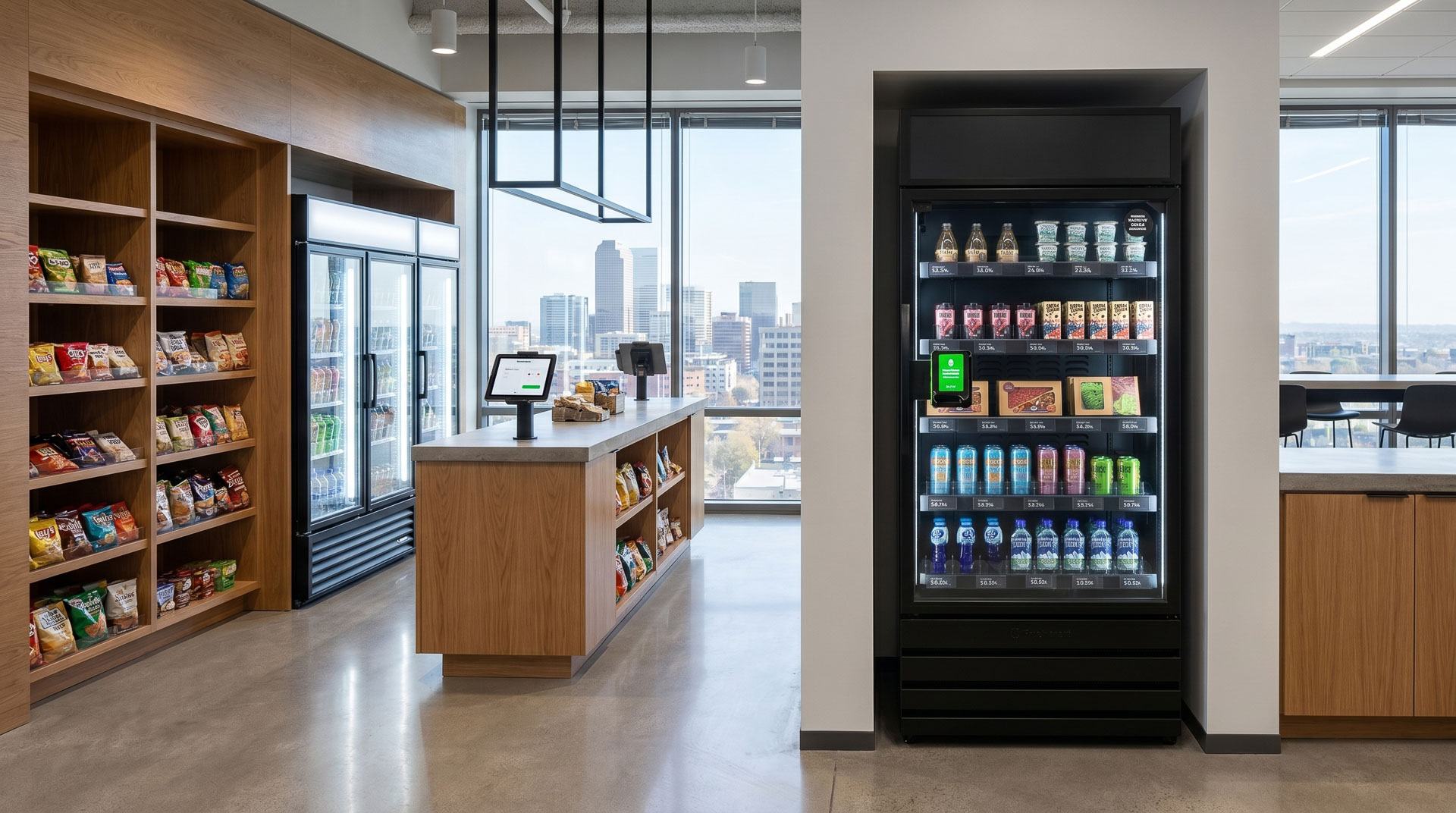
Micro-markets and smart vending both give people convenient onsite access to food, drinks, and essentials, but they solve different operational problems. A micro-market is usually an open retail area with shelves, coolers, and a self-checkout kiosk. Smart vending uses controlled-access machines or smart cabinets that stay locked until payment is authorized.
The right choice depends on your space, staffing expectations, traffic level, security needs, product mix, and how much operational complexity the property or facility wants to take on.
Quick answer
Choose a micro-market when you have enough space, steady daily traffic, and a setting where open shelves can be monitored and maintained. Choose smart vending when you want a compact, cashless, controlled-access amenity that can serve residents, employees, or tenants 24/7 with less space and less open-retail exposure.
For many apartment, office, healthcare, and mixed-use properties, smart vending is the cleaner fit because it offers a modern retail experience without requiring a large room, staffed oversight, or open product displays. For larger staff-only workplaces with strong daily traffic, a micro-market can still make sense.
What is a micro-market?
A micro-market is a small self-service retail area inside a workplace, residential property, or commercial building. It may include open shelving, refrigerated coolers, freezer cases, product displays, and a kiosk or app-based checkout system.
Micro-markets can feel more like a small convenience store than a vending machine. People can pick up products, read labels, compare options, and check out on their own.
That open format is the main advantage and the main tradeoff. It can offer a broader selection and more browsing, but it usually needs more space, stronger oversight, and more trust in the environment.
What is smart vending?
Smart vending uses cashless machines or smart cabinets to provide controlled access to products. In a modern smart store setup, a user authorizes payment, opens the cabinet, takes items, closes the door, and the system finalizes the transaction.
The experience is still self-service, but the products are secured inside the machine. That makes smart vending easier to place in lobbies, lounges, break rooms, mail areas, fitness centers, and other common areas where an open market would be too large or exposed.
Smart vending can include drinks, snacks, quick meals, frozen items, and everyday essentials depending on the equipment and product program.
Side-by-side comparison
|
Category |
Micro-Market |
Smart Vending |
|---|---|---|
|
Space required |
Usually larger |
Usually compact and modular |
|
Product access |
Open shelves and coolers |
Locked or controlled-access units |
|
Checkout |
Kiosk, app, or self-checkout |
Card or mobile wallet authorization |
|
Security exposure |
Higher because products are open |
Lower because products are secured |
|
Product selection |
Often broader |
Curated by cabinet type and demand |
|
Best environment |
Staffed workplaces, high-trust areas, high traffic |
Apartments, offices, healthcare, student housing, mixed-use spaces |
|
Operational complexity |
Can be higher |
Lower when provider-managed |
Neither option is automatically better. The better choice is the one that fits the building and user behavior.
Best fit by property type
|
Setting |
Micro-Market Fit |
Smart Vending Fit |
|---|---|---|
|
Large office or corporate campus |
Strong if traffic is high and space is dedicated |
Strong for satellite areas, lobbies, or after-hours access |
|
Multifamily property |
Limited unless there is a staffed or monitored market area |
Strong for lobbies, lounges, mailrooms, and fitness areas |
|
Student housing |
Possible in large common areas |
Strong for late-night access and essentials |
|
Medical office building |
Possible in tenant-only areas |
Strong when product access should stay controlled |
|
Warehouse or distribution center |
Strong if employee volume supports it |
Strong for compact break areas and shift coverage |
|
Hotel or hospitality back-of-house |
Possible with enough staff traffic |
Strong for compact staff convenience points |
This table is only a starting point. Site layout, access control, product demand, and service expectations should decide the final format.
When a micro-market makes sense
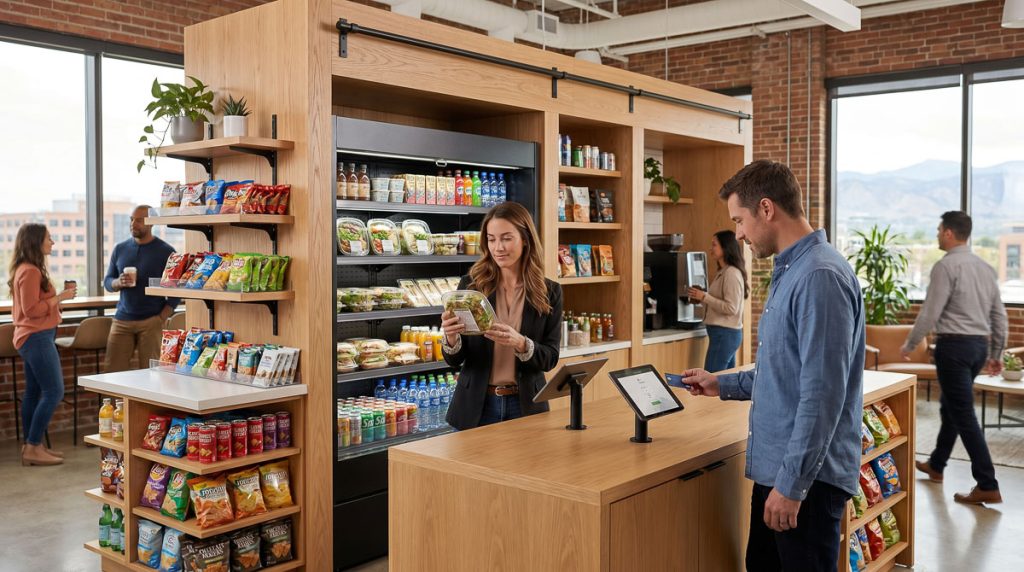
A micro-market can work well when the building has a dedicated break area, strong daily traffic, and an audience that uses the space repeatedly. It is often a good fit for larger offices, warehouses, campuses, and workplaces where employees spend long stretches onsite.
Micro-markets are strongest when:
- there is enough room for shelves, coolers, and checkout
- the area is visible and easy to monitor
- employees or tenants use the space throughout the day
- the product mix needs to be broad
- the operator can restock and maintain the area consistently
The tradeoff is that open retail requires trust and oversight. Products are accessible before payment, so shrink, mess, and checkout compliance can become part of the operating model.
When smart vending makes sense
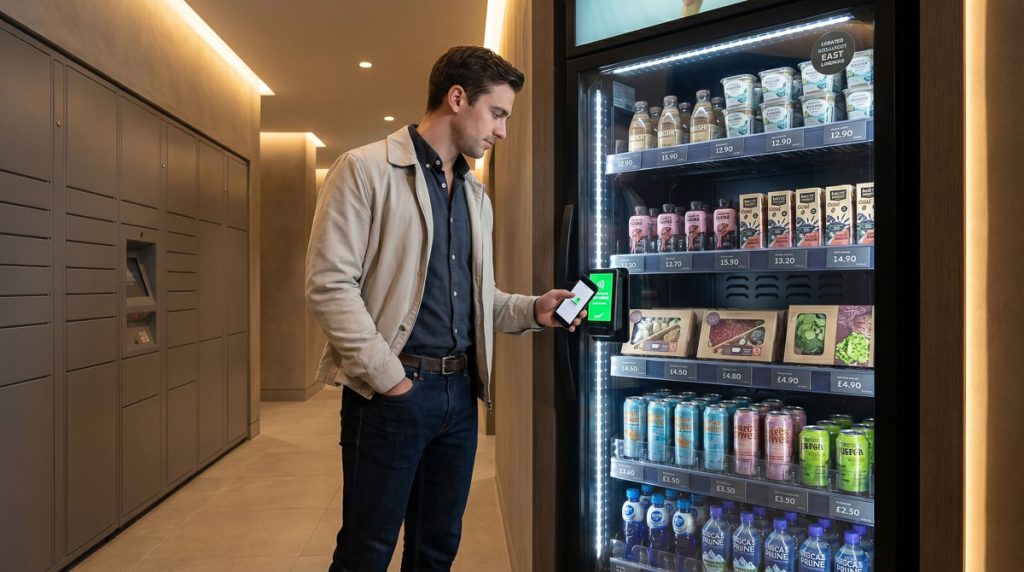
Smart vending is often a better fit when space is limited, the location is open to more people, or the property wants a controlled-access amenity. It can fit in common areas where a full micro-market would be too large or too exposed.
Smart vending is strongest when:
- the property wants 24/7 access without staffing
- products should stay secured until payment
- the footprint needs to be compact
- the product mix can be curated
- the provider will handle inventory, restocking, maintenance, and support
- users want a fast cashless experience
This is why smart vending often works well in multifamily buildings, student housing, medical office buildings, hotels, and smaller office environments.
The security and accountability difference
Security is one of the clearest differences. Micro-markets depend on open access and self-checkout behavior. Smart vending keeps products inside a controlled unit until a valid payment method is authorized.
That does not mean smart vending is a security guarantee. Placement, lighting, building access, cameras, and service response still matter. But controlled-access machines reduce some of the open-shelf exposure that comes with a micro-market.
For property teams, the practical question is whether the location can support open retail. If the answer is no, smart vending usually deserves a closer look.
Product mix: breadth versus control
Micro-markets can often support a wider product set because they have more open display space. Smart vending is more curated. The cabinet format, refrigeration needs, shelf space, and product recognition requirements all shape what should be stocked.
That can be a strength. A curated smart vending setup can focus on the products users actually buy rather than trying to mimic a convenience store.
The right provider should review usage data and adjust the assortment over time. Whether the format is a micro-market or smart vending, stale product selection weakens the amenity.
Cost and staff lift
Property and facility teams should ask what the format requires after launch. Who restocks? Who handles expired products? Who resolves failed payments? Who cleans the area? Who responds when something is broken?
In a full-service smart vending model, the operator handles the day-to-day work and the property provides space and power. That structure matters because the amenity only works if it stays stocked, clean, and supported without becoming another staff assignment.
Micro-markets can also be operator-managed, but the larger open format may create more touchpoints around cleanliness, checkout behavior, and product presentation.
Decision checklist
Ask these questions before choosing:
- How much space do we have?
- Is the location public, semi-private, or staff-only?
- Do we want open shelves or controlled product access?
- How much daily traffic will the area get?
- What product categories matter most?
- Can the provider support refrigerated or frozen products?
- Who handles restocking, payment issues, and service?
- How visible and well-lit is the location?
- Will this feel premium in the building?
- What happens if usage is lower than expected?
The answer should point to the format, not the other way around.
Which is right for you?
Micro-markets are right for properties with enough space, enough traffic, and the right environment for open self-service retail. Smart vending is right for properties that need a compact, controlled, cashless, fully managed amenity that works in common areas without turning the property into a store operator.
For many multifamily, mixed-use, and smaller workplace settings, smart vending is often easier to place and operate. For large staff-only environments with strong traffic and room for open retail, a micro-market may be the better fit.
AI Vending can help property and facility teams compare the two formats and decide which setup fits the space, audience, and service expectations.