
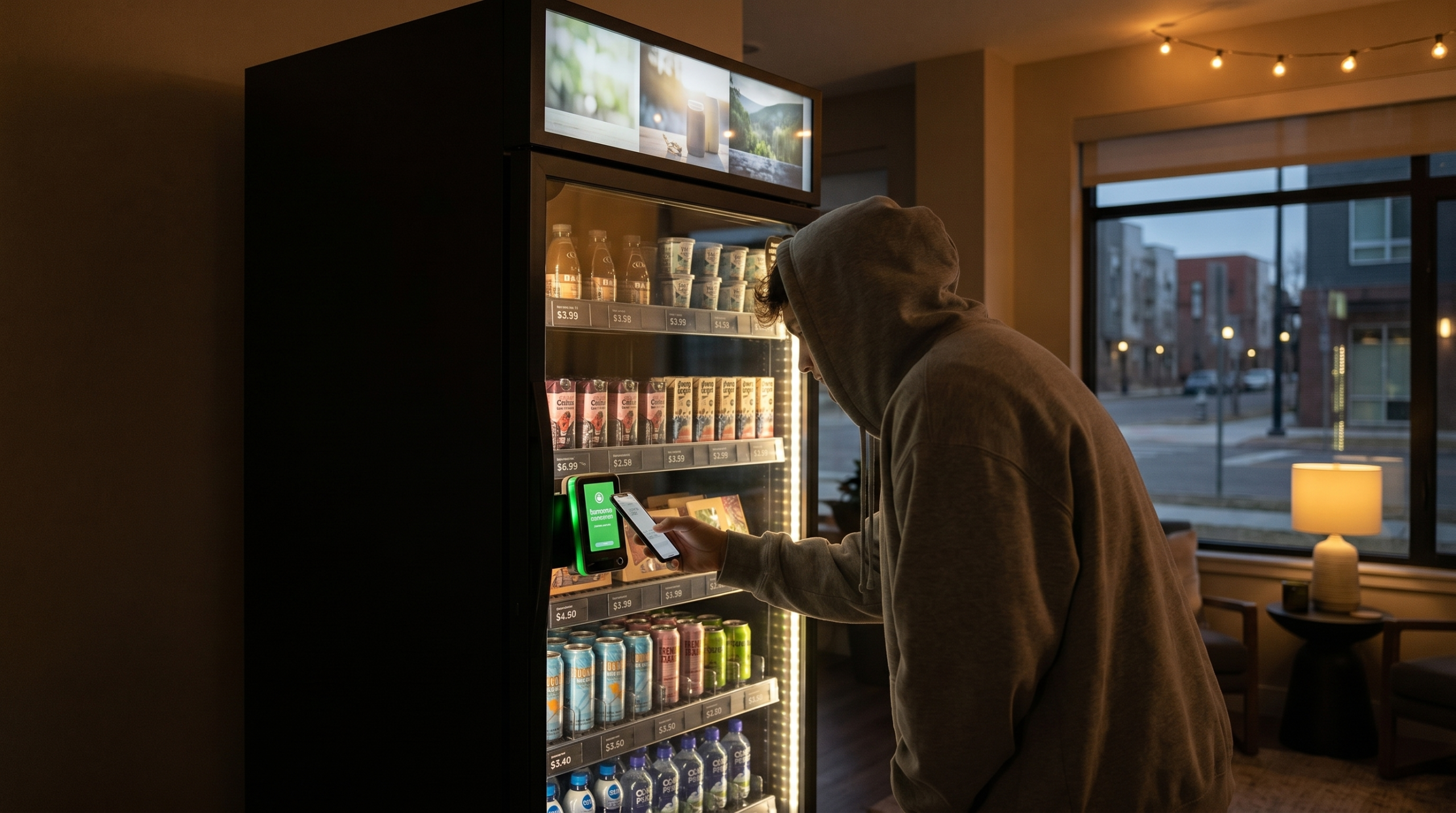
Smart vending gives Denver student housing properties a practical way to support late-night routines, study sessions, and everyday essentials without adding staff coverage. Students get fast, cashless access to snacks, drinks, quick meals, and small necessities, while the provider handles stocking, service, payments, and product adjustments.
For student housing managers, the value is operational as much as it is resident-facing. The right setup can serve students after office hours without asking the onsite team to run a store, track inventory, or handle routine payment issues.
Quick answer
Smart vending for student housing is a fully managed, cashless vending or smart store amenity designed around student schedules. It helps properties provide 24/7 access to food, caffeine, hydration, personal care basics, and tech essentials without adding staff or creating a new daily operations task.
The practical fit is a provider-managed system that can monitor inventory, adjust the product mix, handle service issues, and restock around real demand patterns such as move-in, finals, late-night study periods, and high-traffic events.
Why student housing needs different amenity planning
Student housing does not run on the same rhythm as traditional multifamily housing. Students study late, leave early, come back at unusual hours, socialize in common areas, and often need quick solutions with little planning.
That changes what a useful amenity looks like. Students may not need a formal service desk at midnight, but they may need caffeine, a quick meal, toothpaste, a charger, or something small that keeps their night from getting harder.
Smart vending fits that pattern because it is available when staff are not. It supports small, frequent needs without requiring the property to operate a market, cafe, or staffed convenience counter.
The late-night problem: food, focus, and comfort
The late-night problem is simple: students often need something when nearby stores are closed, delivery is slow, or leaving the building is inconvenient. In student housing, that problem shows up more often than many property teams expect.
It can look like:
- A student studying for an exam needs caffeine or a snack.
- Someone gets home late and has no easy meal option.
- A resident realizes they are out of toothpaste, deodorant, or another basic item.
- A phone or laptop charger becomes urgent during a deadline.
- Students consider leaving the building late for something small.
Smart vending does not solve every student-life problem, and it should not be framed as a safety guarantee. It can reduce one practical reason residents leave the building late by making basics available onsite.
What smart vending looks like in student housing
In student housing, smart vending should feel more like a small always-open convenience point than a traditional machine. The experience should be fast, cashless, and easy to understand.
A strong setup usually includes:
- card and mobile wallet payments
- snacks, drinks, quick meals, and essentials
- remote inventory tracking
- provider-managed restocking
- product changes based on demand
- maintenance handled by the provider
- clear support for payment issues
The system should also be flexible. Student demand can shift around finals, move-in, weather, events, and campus schedules. A smart vending program should adjust when usage changes.
What students actually buy
Students use vending differently throughout the day. The product mix should reflect real routines instead of assuming everyone wants the same snacks at all hours.
| Time of Day | Common Need | Product Categories |
|---|---|---|
| Morning | Wake up and get moving | Coffee, energy drinks, protein bars, breakfast items |
| Afternoon | Between-class convenience | Cold drinks, snacks, grab-and-go items |
| Evening | Dinner backup or social use | Quick meals, sweet snacks, beverages |
| Late night | Study support and urgent needs | Caffeine, salty snacks, meal replacements, essentials |
| Finals or deadlines | Higher demand and stress routines | Energy drinks, quick meals, chargers, personal care basics |
Food and drinks usually drive frequent use, but essentials can make the amenity more valuable. A student may not buy a charger every day, but when they need one, the convenience matters.
Why cashless payment matters
Cashless payment is especially important in student housing because students are used to paying with phones, cards, and mobile wallets. If a machine requires cash or has a slow payment process, many students will simply ignore it.
Cashless smart vending improves the experience by:
- matching how students already pay
- reducing cash jams and coin issues
- making checkout faster
- removing onsite cash from the machine
- simplifying transaction tracking and support
For property teams, cashless payment also reduces the operational burden. There is no cash collection process, and payment questions should be handled by the provider or payment platform.
How smart vending handles peak demand
Student housing has predictable demand spikes. Finals week, move-in, late-night events, weather changes, and busy academic periods can all affect usage.
A good smart vending program should monitor inventory and restock based on demand. That does not mean the unit will never sell out of a popular item, but it should mean the provider can see what is moving and adjust restocking or product mix.
Property managers should ask providers:
- How often is inventory monitored?
- What triggers an extra restock?
- Can product mix change during finals or move-in?
- What happens if a high-demand item sells out repeatedly?
- How are service issues reported and resolved?
These questions matter because student housing demand can be less predictable than standard multifamily use.
A Denver usage signal for 24/7 convenience
Student housing has its own resident patterns, so property teams should be careful about applying ordinary multifamily data too broadly. Still, local usage data can show why after-hours convenience is worth evaluating.
AI Vending’s downtown Denver case study, published March 23, 2026, reported 60.7% resident adoption, 30.4% monthly usage, and 25.9% of transactions between 10 PM and 5 AM at an Avenue5 Residential-managed property. The same case study reported 31.7% stronger demand for full meal options than AI Vending’s per-location average.
Those numbers are not a guarantee for student housing. They are useful because they show that residents use convenience amenities outside normal office hours and that meal options can matter. For student housing, the product mix and restocking plan should be built around the property’s own student schedule.
Where to place smart vending in student housing
Placement should match student movement. The right locations are visible, accessible, and close to where students already gather or pass through.
| Location | Why It Can Work | What To Check |
|---|---|---|
| Lobby or main entry | High daily traffic | Congestion and after-hours access |
| Study lounge | Matches late-night study use | Noise, lighting, and product fit |
| Laundry room | Students already wait there | Clearance, visibility, and power |
| Mail or package area | Regular resident visits | Package-room traffic flow |
| Fitness center | Natural fit for drinks and snacks | Product mix and access hours |
| Common room or game room | Social traffic | Placement that does not crowd seating |
The unit should be easy to find without creating congestion. It should also be placed where residents feel comfortable using it after hours.
What to ask a student housing smart vending provider
Before approving a unit, property teams should ask questions that match student housing operations:
- Who handles restocking, payment support, maintenance, and refunds?
- How often is inventory reviewed?
- Can restocking change around finals, move-in, move-out, weather, or events?
- What student-essential categories can the unit support beyond snacks and drinks?
- How are repeated sellouts handled?
- Can the product mix be adjusted for student price expectations?
- What power, connectivity, airflow, and service access are required?
- What happens if the unit is damaged?
- Does the unit carry cash or operate cashless?
- What does the onsite team have to do after installation?
The answers should make the staffing impact clear. A student housing amenity that creates extra work for the onsite team will be harder to sustain during leasing season, turns, and high-demand academic periods.
When smart vending may not be the right fit
Smart vending may underperform if the only available location is hidden, poorly lit, hard to access after hours, or disconnected from student traffic. A student convenience amenity needs to be easy to find when residents actually need it.
It may also be the wrong fit if the property cannot provide appropriate power, indoor placement, airflow, or service access. Refrigerated and freezer options require more planning than shelf-stable snacks.
The operating model matters too. If the provider expects property staff to report stockouts, handle payment issues, or manage product requests, the amenity can become a burden instead of a solution.
Finally, avoid overpromising the product mix. Student housing may benefit from chargers, toiletries, quick meals, and caffeine, but actual inventory should be based on what the provider can stock reliably and what residents actually buy.
Common mistakes to avoid
The first mistake is stocking only snacks and drinks. Those categories matter, but student housing benefits from essentials too: chargers, basic toiletries, hygiene items, and quick meals.
The second mistake is ignoring late-night usage. If the property chooses products only for daytime behavior, it may miss one of the strongest use cases.
The third mistake is choosing a system that needs staff involvement. Student housing teams are already busy with leasing, resident issues, turns, maintenance coordination, and events. The vending amenity should not become another job.
The fourth mistake is making safety claims too broadly. Smart vending can reduce the need for residents to leave for small items, but properties should avoid claiming that it guarantees safety. Safety depends on many factors, including building access, lighting, staffing policies, and local conditions.
Frequently asked questions
What products work best for student housing smart vending?
Strong categories include energy drinks, coffee, water, snacks, protein bars, quick meals, chargers, earbuds, toothpaste, deodorant, and basic personal care items. The right mix should change based on actual sales data and student feedback.
Can smart vending support late-night study sessions?
Yes. Smart vending is useful for late-night study routines because it gives students access to caffeine, snacks, quick meals, and essentials when stores may be closed or inconvenient. The key is placing the unit where students can use it comfortably after hours.
Does the property team have to restock the machine?
In a fully managed model, no. The provider should monitor inventory, restock products, handle maintenance, and manage payment support. Property teams should confirm this responsibility in writing before installation.
Can smart vending handle finals week demand?
It can help if the provider monitors inventory and adjusts restocking around peak periods. Property managers should ask whether finals, move-in, and other high-demand periods can trigger extra restock planning.
Is cashless vending better for student housing?
Cashless vending is usually a better fit because students commonly use cards and mobile wallets. It also removes cash-handling issues and can reduce problems tied to jammed bills, coins, and change.
Where should smart vending be installed in student housing?
Good locations are high-traffic and easy to access, such as lobbies, study lounges, laundry rooms, mail areas, fitness centers, and common rooms. A site survey should confirm visibility, power, traffic flow, and after-hours comfort.
Support students around the clock
Smart vending works in student housing because it matches student schedules. It gives residents fast access to useful products at odd hours, supports study routines, and reduces the need to leave the building for small items.
For property teams, the value depends on the service model. Choose a provider that handles inventory, restocking, maintenance, payment support, and product adjustments so the amenity stays useful without adding staff workload.
AI Vending can help Denver student housing teams evaluate placement, product strategy, peak-demand planning, and service responsibilities before committing space to a smart vending amenity.
See how AI Vending approaches Denver submarkets.
If you are comparing smart stores, vending, or micro markets across Denver, the Denver location page gives the broader local view across hotels, apartments, offices, and workplace properties.