
Lakewood smart stores and micro markets with a more polished finish.
AI Vending helps Lakewood hotels, apartments, and commercial properties add cashless onsite retail without adding staff workload.
What kinds of Lakewood properties usually get the most value from this amenity?
Lakewood properties tend to be the strongest fit when they have consistent daily traffic but do not want to operate food service internally. Multifamily communities, hotels, office buildings, and mixed-use properties all benefit when the format is matched to the amount of space and the expected purchase pattern.
- West-side hotels and apartment communities usually need convenience that feels polished enough for guest and resident-facing spaces.
- Mixed-use and civic-adjacent properties often want something more credible than an outdated vending bank.
- Buildings with stronger common areas can treat convenience as part of the amenity experience instead of a hidden machine corner.
What footprint usually makes the most sense in Lakewood?
The question in Lakewood is usually whether the building should use a compact smart-store setup, a larger smart-store setup, or a fuller micro market.
- Lakewood smart stores are AI Vending's next-generation vending-machine format, with compact cabinet setups and larger multi-cabinet layouts available depending on the property.
- Compact smart-store setups work well where the property needs a compact format for high-frequency drinks and snacks in a corridor, breakroom, or smaller lobby.
- Smart stores are a strong fit for Lakewood properties that want a more premium amenity presence in the lobby, resident commons, or hotel retail zone.
- AI Vending handles stocking, telemetry, maintenance, and product mix so the program stays hands-off for the onsite team in Lakewood.
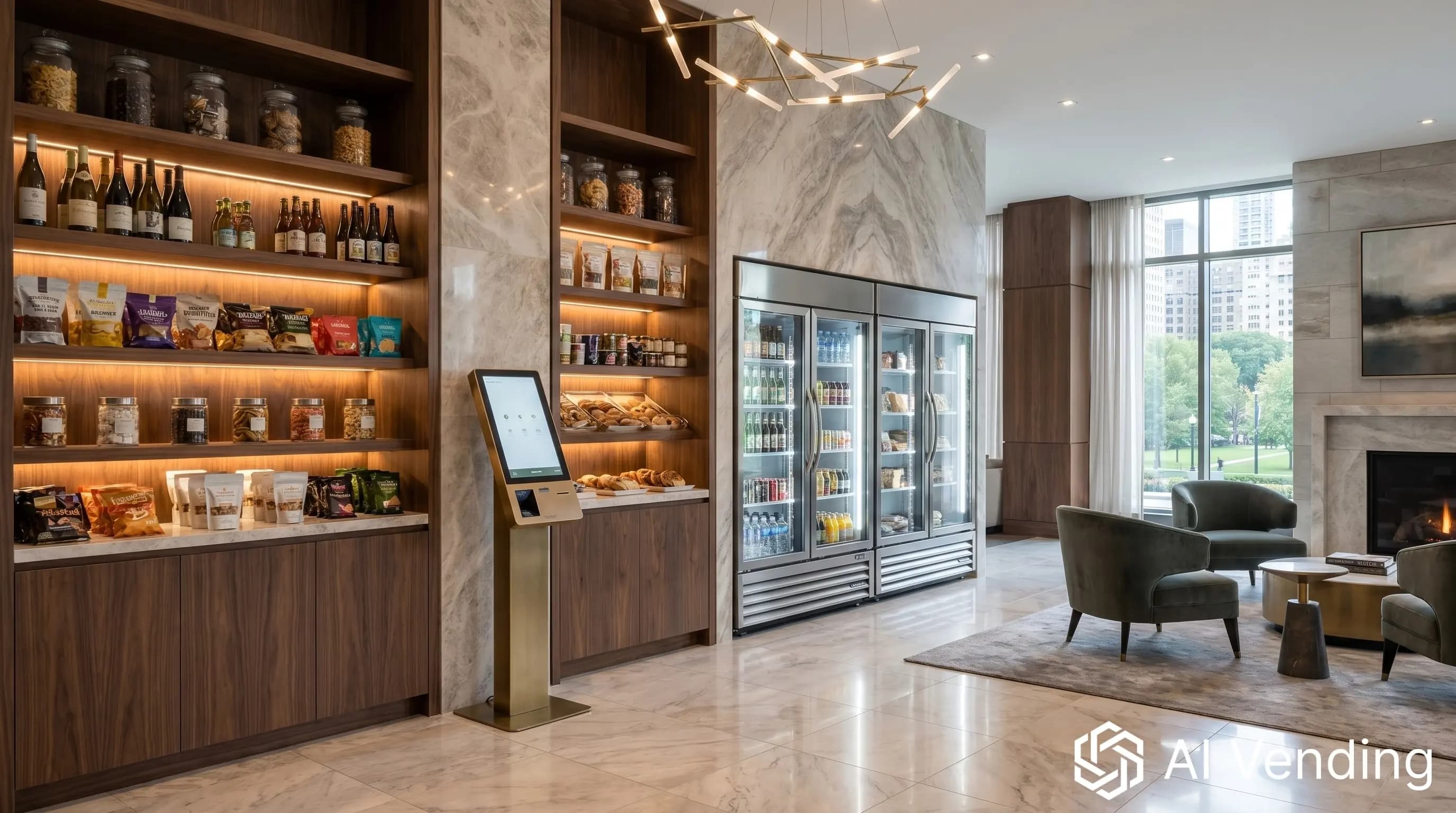
- Micro markets give Lakewood hotels, apartments, and workplaces a broader self-serve retail zone with coolers, shelving, and a more open shopping experience.
- Larger Lakewood footprints can support micro markets that offer a broader range of food and essentials without staffing the space.
- The format works best when a property wants a stronger food-and-beverage offer while still keeping operations outsourced.
How do hotels in Lakewood usually choose the right setup?
For Lakewood hotels, the decision usually starts with available square footage and how visible the retail area should be. A compact smart-store setup works for tight footprints, larger smart-store layouts fit properties that want a stronger guest experience, and micro markets make sense when there is room for shelving, coolers, and a bigger assortment.
Lakewood hotels can use guest-facing compact and larger smart-store setups, or micro markets to cover the moments when travelers want drinks, snacks, and essentials without leaving the building. That is useful for properties serving highway traffic, event nights, and guests who want a fast option before heading toward the mountains or back into Denver.
- Highway traffic, event nights, and westbound travel patterns make quick in-building access especially useful.
- Compact smart-store setups work in smaller lobbies, while more visible guest zones can support larger smart-store presentations.
- The amenity has to stay clean, stocked, and low-lift for the property team to keep working long term.
Lakewood teams are not expected to restock or troubleshoot the equipment after launch. AI Vending manages product curation, replenishment timing, equipment health, and routine service so the amenity feels stable without creating local admin work.
Lakewood brings together west-side multifamily, civic and medical destinations, commuter traffic, and a growing mix of modern common-area expectations. That makes well-managed convenience especially useful for properties that want something more credible than a basic breakroom or outdated vending bank.
The goal is not to force one footprint everywhere. It is to plan around the actual submarket, the hours when people need the amenity, and how much visible common-area space the property can realistically spare without compromising the rest of the building.
Useful reading for Lakewood property teams
Use these resources to compare footprints, understand the operating model, and see how AI Vending frames real deployment decisions in and around Lakewood.
A real deployment showing adoption, late-night usage, and resident response inside a luxury community.
A comparison of footprints, experience, and operational tradeoffs across modern onsite retail formats.
What commercial properties need from a full-service vending and grab-and-go program.
Questions we hear when Lakewood properties start comparing formats
These are usually the practical questions that come up once a team starts weighing space, demand, and rollout effort.
Lakewood properties tend to be the strongest fit when they have consistent daily traffic but do not want to operate food service internally. Multifamily communities, hotels, office buildings, and mixed-use properties all benefit when the format is matched to the amount of space and the expected purchase pattern.
For Lakewood hotels, the decision usually starts with available square footage and how visible the retail area should be. A compact smart-store setup works for tight footprints, larger smart-store layouts fit properties that want a stronger guest experience, and micro markets make sense when there is room for shelving, coolers, and a bigger assortment.
Lakewood teams are not expected to restock or troubleshoot the equipment after launch. AI Vending manages product curation, replenishment timing, equipment health, and routine service so the amenity feels stable without creating local admin work.
Want to plan a Lakewood rollout?
We will look at the footprint, the audience, and whether a compact smart-store setup, a larger smart-store setup, or a micro market makes the most sense for the property. The contact flow stays simple: tell us about the building and we will map the right setup.